
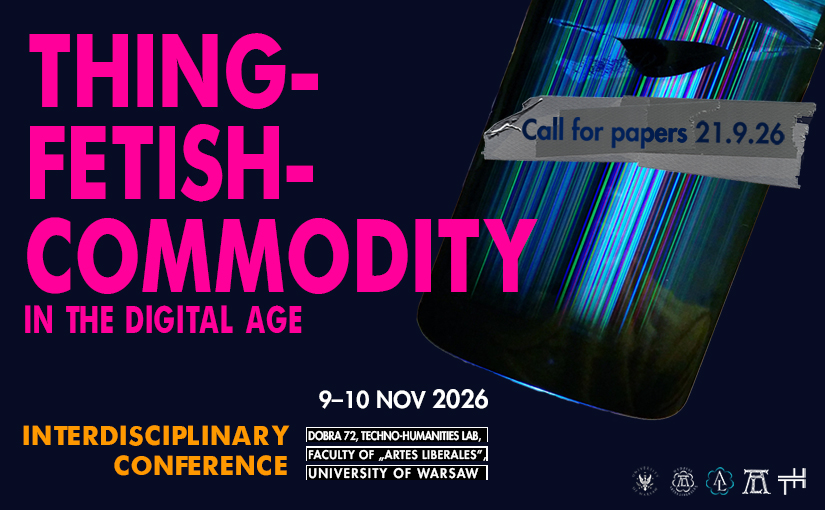
Papers and panels are invited to the interdisciplinary conference “Thing-Fetish-Commodity in the Digital Age”, which will take place in Warsaw from 9-10 November 2026. The conference, organized by the Faculty of “Artes Liberales” at the University of Warsaw (Poland), is part of the “Technology and Socialization” project directed by the Techno-Humanities Lab.
In the contemporary world, we are still surrounded by material objects – tables, books, buildings, cars, etc. However, we are increasingly surrounded by digital objects, such as online videos, photos, text files, social media profiles, electronic notifications, digital tickets, financial transactions, etc. The enigmatic nature of digital objects stems from the fact that they exist both on the screen, where we can interact with them symbolically, and in the background, in the processor. In his book On the Existence of Digital Objects, Yuk Hui notes that digital objects appear to users as visible entities, but at the programming level, they are text files; and in the operating system, they are binary codes; and finally, at the physical level, signals generated by voltage values and the results of logic gate operations. The question arises: what is a digital object and what constitutes its enigmatic life cycle, if it is hidden beneath many heterogeneous layers? Can we perceive the life cycle of a digital object as a constant dual movement – from object to data and from data to object? But what does this movement consist of, and what does it mean to be in relation to a moving digital object?
Psychoanalysis, addressing the subject-object relationship from Freud to Lacan, emphasizes that the way a person finds an object is always a consequence of an impulsive tendency, involving a lost object that must be rediscovered. Nostalgia binds the subject to the lost object. This fact marks the search for the object and the relationship with it with the stigma of repetition. The primacy of the dialectic of search and disillusionment creates a tension in the subject-object relationship, suggesting that what is sought will never be found. It is through the search for an object of satisfaction, which is both passé and depassé, that a new object is found in a place other than the one in which it is sought. Moreover, the concept of the object in psychoanalysis is closely linked to the concept of the fetish. It is impossible not to forget that the object serves a certain complementary function in relation to something that appears as a hole, or even an abyss.
The question, then, is whether there is a common denominator between fetishes and objects. In short, from a psychoanalytic perspective, do all objects become fetishes in some sense, filling an ontological gap? In Seminar IV, titled “The Object Relation”, Jacques Lacan explicitly claims that in the world of objects, there is one that performs an absolutely and paradoxically decisive function – namely, the phallus. Lacan concludes: “In fetishism, the subject finds its object, its exclusive object, and speaks of it itself. This object is exclusive and fully satisfying because it is inanimate. In this way, the subject achieves peace, knowing that the object will not disappoint him. To love a slipper is, in fact, to have the object of one’s desires within reach.”
Axel Honneth, in his 2005 lecture entitled Reification: A New Look at and Old Idea states that in the world of the 1920s and 1930s, the concept of reification was a leitmotif of social and cultural criticism. It was Georg Lukács, combining motifs from the works of Karl Marx, Max Weber, and Georg Simmel, who reclaimed the concept of reification in a book published in 1925 titled History and Class Consciousness. After World War II, the primacy of “reification” as a leading diagnostic concept was lost. Although these concepts persisted in the writings of the Frankfurt School – especially in the works of Theodor Adorno – the project of analyzing reification began to feel like a bygone era. The mere mention of the term “reification” was often perceived as a sign of intellectual regression. Only recently have there been increasing signs of a shift in the intellectual climate. The category of “reification” re-emerged and took center stage in theoretical discourse. But how? What new meanings did this category acquire?
Lukács did not perceive reification as a violation of moral principles, but as a characteristic feature of the capitalist form of life. The arguments he raises against the reification of social life are only indirectly normative. In this sense, one could say that Lukács’s analysis provides a socio-ontological explanation for a particular pathology occurring in the practices of life. However, it is uncertain whether we can speak of reification in the same way today. Can we justify opposition to a particular form of life by appealing to ontological or anthropological exaggerations? Indeed, it is not even clear whether, given the demands contemporary societies place on the coldly calculating intellect, we can even employ the concept of reification coherently.
Axel Honneth concludes his lecture on the long journey of the concept of reification with the conviction that “reification” is the fruit of forgetting the concept of “recognition.” Judith Butler, commenting on Honneth’s lecture, asks: if “reification” appears within social relations, does the “return” of authentic practice, which is supposed to hide from our instrumental attitudes, allow us to find a panacea for reification? For Butler the concept of “authentic bond” functions as a primal myth that precedes calculating society, a foundation of the social. Unfortunately, building bonds in conditions of dependence is not easy. It gives rise to the constant need for aggression, severance, and separation on the one hand, and on the other, dependence, helplessness, and frustration that transform into endless debt.
In this triple theoretical context defined by critical theory, psychoanalysis and digital object theory, during the conference we would like to ask:
-
-
- What is the relationship between: a thing (attractor), a device (a set of functions), an organism (a deliberate combination of organs), and a computing machine (a self-correcting automaton)?
- Do we have strong reasons to speak of the “reification of humans” when the dominant climate of our times is rather “anthropomorphization” or the “vitalization” of digital objects (Artificial Intelligence)?
- Do we belong not so much to some environment, surroundings, Umwelt, biosphere, but mainly to the infosphere, which is a generalization and densification of the technical environment in which man – as Luciano Floridi would say – becomes an “inforg” (informational organism) – a mediator between the devices that make up the Internet of Things?
- To what extent are digital objects new technical objects that serve only the optimization of business goals, not engineering ones, which is an open suggestion that modern technologies have, from the very beginning, served economics (financial transactions), and not rationality in any sense?
- Are there reasons to agree with Byung-Chul Han’s hypothesis, according to which things, due to their permanence, once provided support to humans, had their own history and evoked memories, while information (Non- things: smartphone, selfie, digital photo, cloud, AI) due to its transience and momentariness destabilizes human life and leads to ultraliberal regimes of self-control, self-employment and self-exploitation?
- Are there strong reasons to agree with Martin Heidegger’s conviction, who already in 1949, called for a return to the original meaning of the word “thing” (das Ding), meaning “to gather.” The jug for example is a thing insofar as it gathers. The secret of the thing lies in the fact that it cannot be represented as something that stands against – Gegenstand – but rather should be understood as an “assembly of beings” in which Being is revealed. The difference between an object and a thing – for Heidegger – is that the thing remains autonomous and yet constitutes the focus for a specific assemblage, while the object stands against something; the thing gathers, the object establishes distances.
- Today, we are observing a surge of interest in object theory. Thomas Nail, in Theory of the Object, considers the existence of the moving and chaotic Loop Object; Yuk Hui examines the forms of existence of Digital Objects, which are strictly relational, not substantial; Brian Cantwell Smith examines the boundaries of objects, arguing that the discreteness of objects has long since escaped our control. Finally, Timothy Morton analyzes “hyperobjects” – “entities of such vast temporal and spatial dimensions that they defeat traditional ideas about what a thing is in the first place”. How should we interpret this surge of interest in object theory? Is it a symptom of our ontological concern that traditional ontologies fail to describe the world around us?
- Are we the first bourgeois society deprived of the permanence of things, and the last to still remember this permanence? And is this permanence of things, settled in the unconscious, a contemporary form of “good reification,” because it is the thing, not the person, that remembers?
-
Presentations are expected to last 20 to 30 minutes. Please send abstracts of up to 300 words, attached in a Word document, along with a short bio to technologyandsocialization@gmail.com by 21 September, 2026.
Should you need any further information, do not hesitate to contact us at the same email address. All information about thethe “Technology and Socialization” project can be found here. We are looking forward to your participation and to hosting you in Warsaw.
Organizing Committee:
Professor Szymon Wróbel
Katarzyna Szafranowska, PhD
Adam Cichoń, MA